The Süleymaniye Mosque—a masterpiece by Mimar Sinan and a symbol of the Ottoman Empire’s golden age
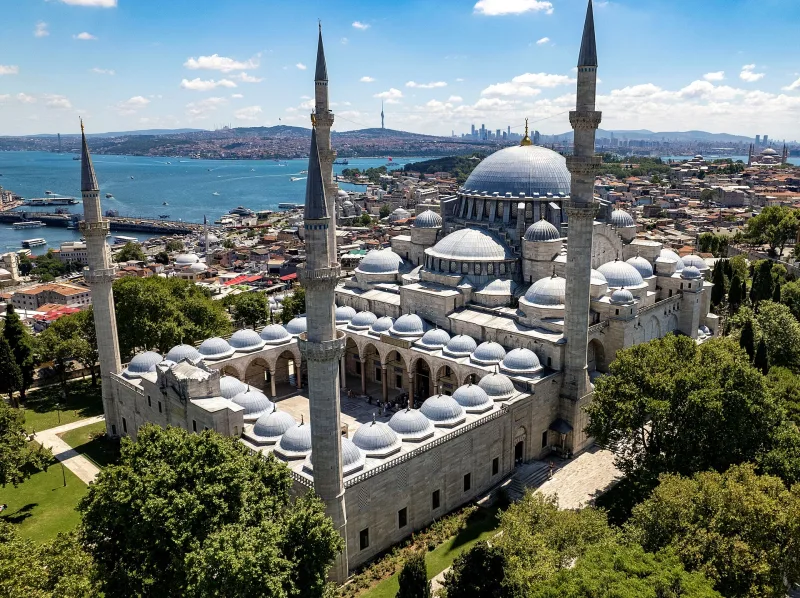
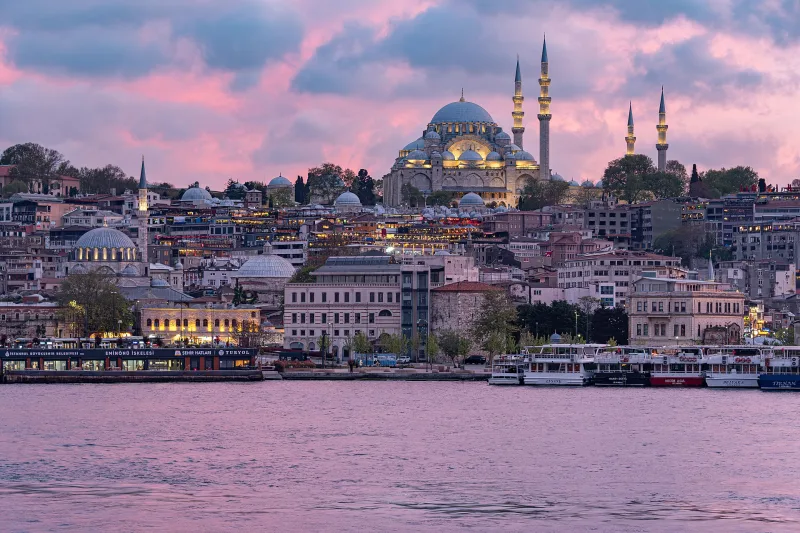
The Süleymaniye Mosque (Süleymaniye Camii) is the most majestic imperial mosque in Istanbul and one of the chief masterpieces of the architect Mimar Sinan, built for Sultan Suleiman the Magnificent between 1550 and 1557. Erected on the Third Hill of Old Istanbul, it dominates the Golden Horn and remains the finest example of classical Ottoman architecture. In 1985, along with the rest of historic Istanbul, the Süleymaniye was inscribed on the UNESCO World Heritage List. It is not merely a mosque, but a vast “külliye”—a complex of religious, educational, and charitable institutions reflecting the imperial grandeur of Suleiman’s era. Many architectural historians consider the Süleymaniye, rather than the later and more famous mosques of Istanbul, to be the absolute pinnacle of Ottoman architecture—the ideal response to the Byzantine Hagia Sophia and, at the same time, its creative surpassing.
History and Origin of the Süleymaniye Mosque
By the mid-16th century, the Ottoman Empire was at the height of its power. Sultan Suleiman I, known in the West as the Magnificent and in the East as Kanuni (the Lawgiver), completed the territorial expansion from Buda to Baghdad and from Crimea to Yemen. He ruled for over 46 years, and his reign became the empire’s golden age. By tradition, every sultan was required to build an imperial mosque, usually financed from war booty. For Suleiman, such a mosque had to be the most magnificent—a symbol of his power, wealth, and piety.
In 1550, Suleiman commissioned the construction to Mimar Sinan, the chief court architect, who had already distinguished himself with a dozen outstanding works. By that time, Sinan was a seventy-year-old experienced architect, and the Süleymaniye became his largest project. Sinan himself would later say that the Süleymaniye was his “apprentice’s work,” while he would name the later Selimiye Mosque in Edirne as his true masterpiece. Construction lasted seven years, and the mosque was solemnly inaugurated in 1557 in the presence of the sultan, who received the keys to the symbolic gates.
Over nearly five centuries of existence, the Süleymaniye has survived several disasters. The first major fire in 1660 damaged the interiors; Sultan Mehmed IV oversaw the restoration in the Baroque style, which partially distorted the original design. The 1766 earthquake caused part of the dome to collapse. During World War I, the inner courtyard served as an ammunition depot, and a fire caused by an explosion inflicted further damage. A large-scale restoration was carried out between 1956 and 1960, restoring the mosque to its classic appearance. In 2010, a new wave of interior restoration work began, and the mosque is now in excellent condition.
Architecture and What to See at Süleymaniye
Suleimaniye is the purest embodiment of 16th-century classical Ottoman architecture. Its proportions, stonework, lighting design, and engineering solutions are considered the gold standard of the genre.
The dome composition is the perfect solution
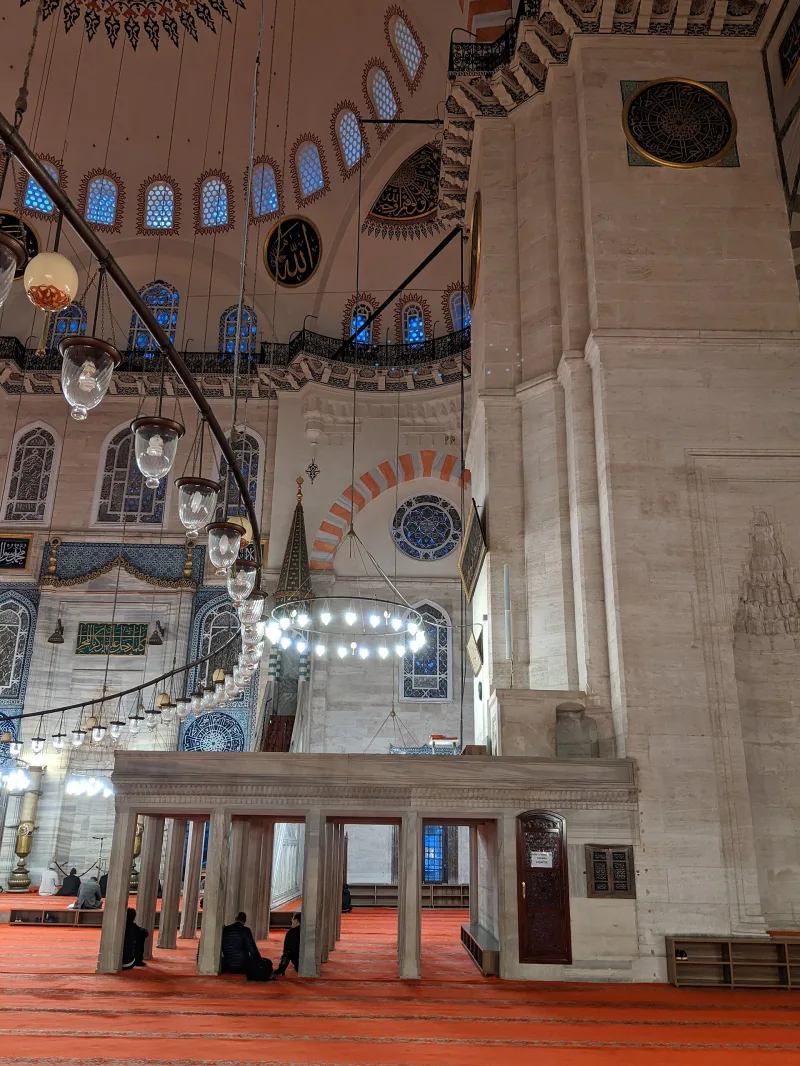
The main dome of Süleymaniye has a diameter of 27.25 meters and a height of 53 meters (exactly twice the diameter—a classic ratio). The dome rests on four massive pylons and is supported by two large half-domes on either side—a design clearly inspired by Hagia Sophia but developed into a lighter and more elegant form. Unlike the Blue Mosque with its cascade of half-domes, the system here is simpler and, at the same time, technically more sophisticated. The interior space—an almost perfect square measuring 58.5 × 57.5 meters—creates an impression of spaciousness and lightness, which Sinan sought to achieve throughout his life.
The Four Minarets and Their Symbolism
The Süleymaniye Mosque has four minarets with a total of ten balconies (sherifs). This symbolizes the fact that Suleiman was the fourth Ottoman sultan to rule in Istanbul after the city’s conquest and the tenth sultan in the Ottoman dynasty. The two minarets at the entrance to the main courtyard are taller (about 72 meters), while the other two, shorter ones, stand at the corners of the mosque itself.
Interior Decoration and Stained Glass
The interior of the Süleymaniye is modestly decorated compared to later mosques: elegant Iznik tiles are found only around the mihrab, while the main part of the walls is covered with austere calligraphic paintings. The famous stained-glass windows by the master Sarkhosh Ibrahim (Ibrahim the Drunkard) flood the mihrab with colored light—a technique first applied on such a scale precisely here. The mihrab and minbar are made of white marble with delicate inlay work.
The Külliye and Türbe Complex
Surrounding the mosque is a vast külliye complex, built at the same time as the mosque: four madrasas (theological schools), a medical school, a hospital (timarhane, one of the world’s first psychiatric hospitals), an imaret (soup kitchen for the poor), a caravanserai, an elementary school, shops, and bathhouses. It was a veritable “city within a city,” where thousands of people studied, received medical care, and found assistance. To the east of the mosque are two türbes (mausoleums)—those of Sultan Suleiman the Magnificent himself and his beloved wife Roksolana (Hürrem Sultan). The tombs are decorated with exquisite Iznik ceramics and are considered masterpieces of Ottoman art in their own right.
The Tomb of Mimar Sinan
In the northwest corner of the complex, next to the mosque, lies the modest grave of Mimar Sinan himself—the architect who built over 300 structures and lived to be 98 years old. This is the only building of his in which he is buried.
Mimar Sinan: A Janissary Who Became a Genius
The architect’s own story is no less fascinating than that of his masterpiece. Sinan was born around 1489 into a Greek-Armenian family in Cappadocia and was recruited into imperial service through the devşirme system. He rose from a simple military engineer in the army of Suleiman the Magnificent (building bridges and siege engines) to chief court architect—a position he held for over 50 years. During this time, Sinan designed over 320 structures: 92 large mosques, 52 small ones, 57 madrasas, 48 bathhouses, 35 palaces, 22 mausoleums, 20 caravanserais, 17 imarets, and numerous bridges, the most famous of which is the Mehmed Pasha Bridge over the Drina River in Bosnia (also a UNESCO site). Sinan considered three of his works to be his masterpieces: the Şehzade Mosque in Istanbul (“the work of a student”), the Süleymaniye (“the work of an apprentice”), and the Selimiye in Edirne (“the work of a master”). He died in 1588 at the age of 99 and is buried at the foot of his own masterpiece—in a modest mausoleum on a street he designed himself.
Engineering Secrets of the Dome and Acoustics
The secret to the strength of the Süleymaniye dome lies in a carefully designed system of buttresses and relieving arches. Sinan distributed the dome’s weight across the semi-domes, arches, and massive pylons in such a way that the building could withstand strong earthquakes without collapsing—and indeed, over nearly five hundred years, the mosque has survived dozens of tremors. The ventilation system deserves special attention: above the mosque’s entrance is a small chamber where soot from oil lamps and candles was concentrated and prevented from settling on the walls and carpets. Sinan used the collected soot to make high-quality ink, which was supplied to the sultan’s chancellery. This is a true example of 16th-century ecological thinking that was ahead of its time. The mosque’s acoustics are also mathematically calculated: 64 clay resonators in the dome allow the imam’s voice to sound evenly in every corner of the hall, without echoes or distortion—an effect that modern acousticians measure and still try to explain.
The Külliye Complex as a Social Institution
The Suleymaniye Külliye was not merely a religious institution but the largest social center in 16th-century Istanbul. The imaret fed up to 1,000 people daily for free—the poor, students, and travelers. At the Timarhane Hospital, a treatment for mental disorders unique for its time was practiced using music, water therapies, and conversations with doctors—two centuries before a humane approach to psychiatry began in Europe. More than 600 students studied at the four madrasas, learning the Quran, hadiths, law, mathematics, astronomy, and medicine. The külliye’s library housed one of the largest manuscript collections in the Ottoman Empire—today these manuscripts are distributed among the Süleymaniye and Topkapı libraries.
The Tombs of the Sultan and Hürrem Sultan
Two mausoleums to the east of the mosque deserve special attention. The tomb of Suleiman the Magnificent is an octagonal building with a dome, decorated inside with magnificent Iznik tiles featuring floral motifs. In the center is the sultan’s own sarcophagus, covered with green fabric featuring gold calligraphy; nearby are the tombs of his two daughters and heirs. The tomb of Hürrem Sultan (Roxolana) is smaller in size but no less exquisite. Her sarcophagus is decorated with red tiles featuring tulips—her favorite flowers. Hürrem was the first sultana to receive official status as the sultan’s wife and to be buried in the imperial mausoleum; her tomb became a symbol of the beginning of the “Sultanate of Women”—a period when the women of the harem exerted significant influence on the empire’s politics.
Interesting Facts and Legends
- The engineering marvel of the Süleymaniye Mosque is its system of sub-dome resonators: 64 hollow clay pots are built into the dome’s structure, improving acoustics and allowing the imam’s sermon to be heard throughout the hall without modern amplification.
- Sinan personally inspected the quality of the lime and stone, standing by the foundation for hours on end. Legend has it that he refused to begin construction of the dome until the lime in the mortar had “matured” over the course of several years.
- The mosque stands on the steep slope of the Third Hill, and Sinan undertook massive work to reinforce the foundation: massive basements and water cisterns are hidden beneath the building, serving both as support and protection against seismic vibrations.
- Traces of restorations from various eras are still visible on the tomb of Sultan Suleiman and Roksolana, yet at its core lies original Iznik ceramics from the mid-16th century, among the finest in the world.
- After the fire of 1660, some of the restoration work was carried out in the Baroque style, but in the mid-20th century these elements were removed, and the mosque regained its original austere appearance.
How to get to the Süleymaniye Mosque
The Süleymaniye Mosque is located in the Old City, atop the Third Hill, within walking distance of the Grand Bazaar (about 10 minutes) and the Egyptian Bazaar in Eminönü (15 minutes). The nearest T1 tram stops are “Beyazıt-Kapalıçarşı” or “Eminönü.” From there, walk uphill through the narrow streets for about 10–15 minutes. For those who prefer not to walk uphill, you can take a taxi directly to the mosque’s south entrance.
From IST Airport, it’s easiest to take the M11 metro to Kâğıthane, then the M7 and the T1 tram. From Sabiha Gökçen Airport, take the Havabus to Taksim and then on to Eminönü. Admission to the mosque is free for everyone; visits are permitted during daylight hours, except during the five daily prayers. The best time to visit is the latter half of the morning or the afternoon, outside of prayer times.
Tips for travelers
Allow at least 1–1.5 hours for the Süleymaniye Mosque: the mosque itself, the two türbes, the courtyard with the fountain, and a walk around the complex. Be sure to go out onto the northern terrace behind the mosque—it offers one of the best panoramic views of Istanbul, including the Golden Horn, the Galata Tower, and the Bosphorus. Many consider this view even better than those from the observation decks in Galata or Eyüp.
The dress code is the same as everywhere else: women must cover their heads, shoulders, and knees; men are not allowed to enter in shorts. Scarves are provided free of charge at the entrance. Shoes must be removed and carried in a plastic bag. Inside, the mosque is less crowded than the Blue Mosque or Hagia Sophia, making it an ideal spot for quiet contemplation and great photos without the crowds. Near the mosque, there are several restaurants with views of the Golden Horn—the “Süleymaniyeli Ağa” is particularly famous for its classic Turkish chicken dishes.
Be sure to visit the tombs of Sultan Suleiman and Hürrem Sultan—there is a separate entrance, but admission is free. For fans of the TV series “Magnificent Century,” this is almost a pilgrimage: here lie the heroes of an era that transformed Ottoman history. The best time for photos is in the morning, when soft light highlights the domes’ proportions, or during the golden hour before sunset, when the mosque is bathed in warm light. The Süleymaniye Mosque is a place where you realize that imperial architecture can be both grand and restrained, impressive without excess, and that great architects are measured not by the number of ornaments, but by the purity of their proportions.